
This is everything you ever wanted to know about launching an RFID pilot with Checkpoint Systems. If you’ve ever wondered how we help our partners plan a store pilot, how we approach A/B tests, how we set and measure success metrics, and how we help you scale afterward, then you’re in the right place. We’ve taken all your top FAQs, from the planning phase to scaling worldwide, and answered them as part of a new RFID blog series.
To make sure we’re answering your FAQs thoroughly, we called up our experts. Please put your hands together for David Murrihy (Sales Director of ALS) and Steven Campbell (Business Unit Director) from our Australia and New Zealand teams, plus Brian Dilts (Senior Sales Director) and Scott Reithmeier (Director of Sales) from our U.S. team.
Take it away, fellas!
Do you have RFID starter kits or pilot packages?
Yes! But before you get rolling on your RFID pilot program, our client success team and tech teams will schedule a visit. They’ll do a blind scan of your store to identify how many products are already RFID tagged, what your current inventory accuracy is, and what a good business case might look like for you. “There are different models for how we might provide and charge for pilot starter kits. It’ll be tailored to your needs,” says David.
“We can provide the handheld labels and the software package, that's all out of the box, basically plug and play,” says Scott. “We even have a one-pager detailing how to set up your handheld and make sure the software is running. We actually do that for full rollouts — we did that for one of our sports apparel clients. They had 1,100 stores, and every store got their hardware kitted in a box. It was a handheld, the charger, a one-page instruction sheet.”
“From the labeling side, we help choose the right labels from our options and then get them scanned and ready for the kits. So, it's a straightforward application when it comes to the pilot” adds Brian.
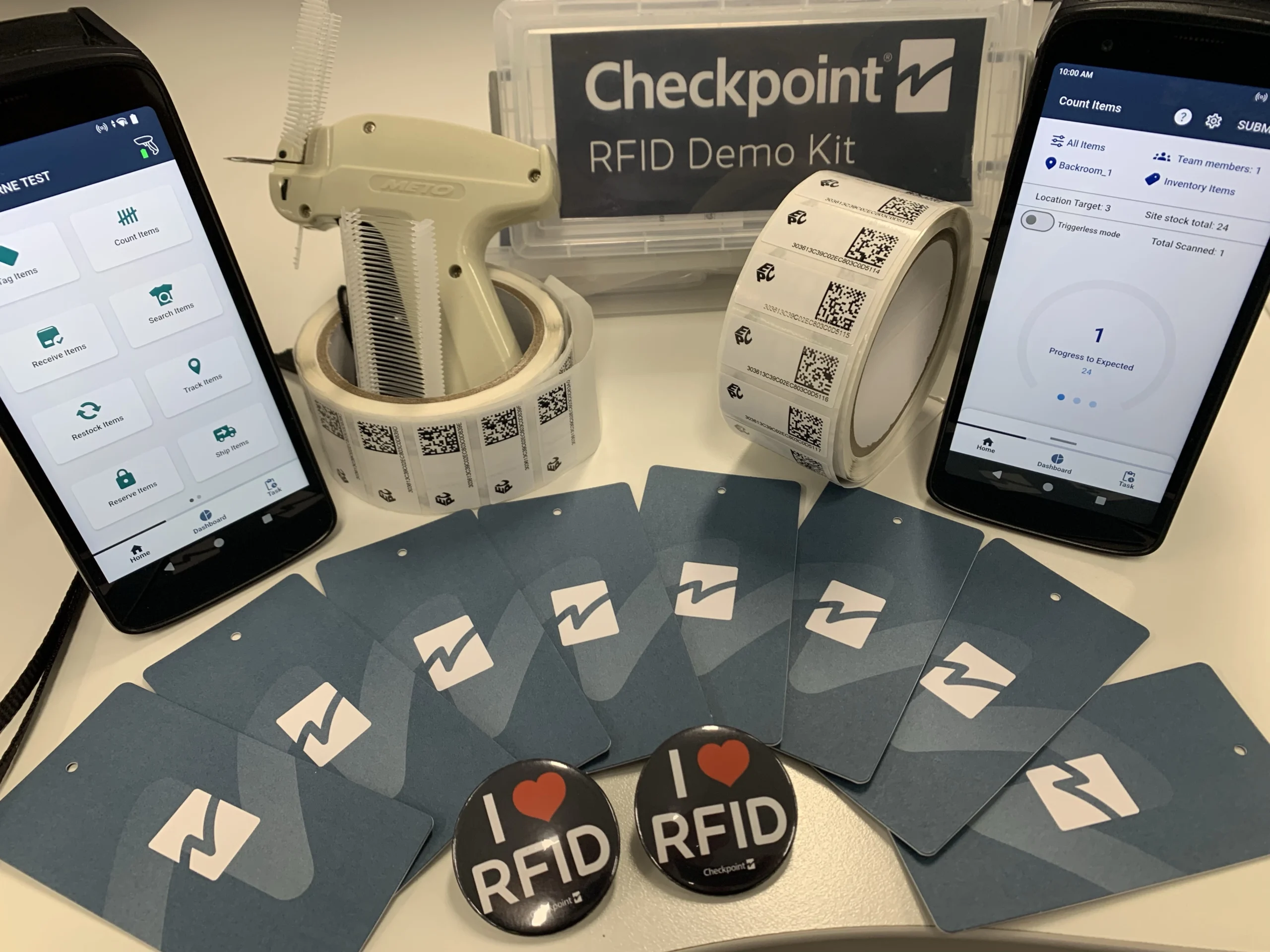
An example of an RFID Store Kit
Do you run A/B tests between stores to measure RFID impact?
Yes, we do. We advise clients to identify similar stores for comparative testing, and generally do the pilot with more than one of each. “You might have two or three or four stores doing RFID, matched to two or three or four stores without RFID, where they've got like-for-like tracking beforehand and like-for-like tracking once the RFID comes into play,” says David.
After our team has done the initial store scan to determine your baseline inventory accuracy, we can start measuring the sales lift your RFID pilot brings in. Scott says, “We’ve worked with client finance teams for several pilots, and they were able to report the sales that they saw across SKUs in the RFID stores. That’s what led them to adopt it.”
It’s also critical to consider moving your RFID tagging to source and deciding which tag or ticket types you want to use and what volumes you need in which overseas factories. “That takes probably three months to organize the stock, and in those three months, we also need to get you set up in CheckNet,” says David. “That's our data platform that we drive all our apparel labeling projects, RFID and non-RFID, through. Once we automate that and it's set up in CheckNet, it just makes the whole thing seamless.”
How do you approach running an RFID pilot if you want to scale globally afterward?
We’ll help you pick a subset of stores that represent your chain. We usually recommend three to five locations, excluding your best and worst, as they can skew results. After that, we’ll work with you to map out a staged rollout approach. Scott says:
“A regional approach typically works really well. If you have 500 stores spread across eight regions, go one region at a time. So, region one goes this month, and then region two, then region three, and then as you start scaling that, you might see that you can go faster than your initial deployment plan. Make sure each store is comfortable before you move on.”
It’s also critical to consider moving your RFID tagging to source, considering the tag or ticket types you want to go with, and which volumes are needed in which overseas factories. “That takes probably three months to organize the stock, and in those three months, we also need to get you set up in CheckNet,” says David. “That's our data platform that we drive all our apparel labeling projects, RFID and non-RFID, through. Once we automate that and it's set up in CheckNet, it just makes the whole thing seamless.”
What kind of technical support and on‑site service would you give for complex, multi‑store RFID deployments?
“The first stage is a discovery workshop,” says Steven. “In the Australian team, we have a program manager, almost like pre-sales, that goes in and goes right, ‘Tell me everything, and I'll give you some ideas of how we use it.’”
Your project is supported by three Checkpoint departments: project management, solutions architects, and the technical support team, who work closely with our client success manager to identify key use cases. Scott says:
“They’ll help on the technical side of what integrations are needed for those use cases, and then oftentimes they're on site as well for the initial go-live to help from a support standpoint. To make sure there are no issues and the software is working as it should, and they're there for the duration of the pilot as well.”
“We can send hands to the store to support the team and help with the initial tag-up and show the tagging standards or the do's and don'ts,” adds Brian.
Do you have experience rolling RFID projects out across different regulatory environments worldwide?
From a GDPR and privacy standpoint, your RFID project is unlikely to be an issue. “RFID is only tracking the products. It's not tracking people, your lifestyle, where you live,” says David. “We get this question a lot, but RFID doesn’t track people-linked data, so it's not an issue.”
If you’re concerned about different RFID frequency standards worldwide, our team has you covered. “From a tag perspective, nothing changes. From a software perspective, the U.S. uses a different frequency band than Europe. I think China uses the same one as the U.S. The only thing that really changes is ensuring that the labels you choose for your deployment, if you are spread across multiple regions, are consistent across those different frequency ranges,” says Scott.
Is recyclability the main concern when using RFID in different regulatory environments? Well, you guessed it — we can provide guidance to help you make the best choice. “We’ll work with your packaging team to understand the market you’re selling to and how to be compliant in that market,” says Brian.
Do you give documentation to help integrate RFID with existing loyalty and CRM systems?
Yes, we can provide documentation. However, RFID data is purely for inventory tracking, and many large retailers using data for CRM pull it from elsewhere. “Big retailers have that CRM data already. They know what customers bought,” David says. “They're already doing that; RFID just gives them more accuracy around their stock levels.”
“I just presented to the COO of a company last week,” says Scott. “They're only displaying inventory on customer-facing applications that have at least three or more items of known inventory in stock. So, they're not even exposing a percentage of their inventory in store. RFID will give you confidence in the data. You'll be able to display down to the last item what you know you have in those stores, and it'll drive sales across those platforms. But you're not necessarily integrating directly from that CRM to Checkpoint. You'll do what you do now but think of us as feeding the engine that drives that CRM with more frequent, accurate data,” says Scott.
“There’s quite a library of API data that can be shared with the customer. At any read point, it’s always going to be ‘What did we read; why did we read it; when did we read it?’ So, if the ‘why’ is a purchase and we can connect it to a time that matches a customer loyalty card, then it can be related in an API pool. There's a technical document there. We can give you everything available, but it’s a case of identifying what’s useful and what’s not,” says Steven.
Do you have experience deploying RFID in busy, high‑theft environments?
Yes, we’ve got plenty of it — when RFID is deployed, it’s usually in a flagship due to the ROI benefits. “All that RFID data is filling a back metric to say, ‘Hey, replenish that stock that's just left the store. You've got one out the back, get it on the floor.” Now you can do that Zara-style sweep during the day and ensure that you've got the full ensemble in your presentation,” says Steven.
“RFID on its own won't stop loss. If it's a high theft area, you're still going to get theft,” says David. “With RFID, you know you had an item yesterday but haven't got it today. After two or three counts, you know you don't have the stock, and you just replenish. By replenishing, there's a chance you'll sell more stock.”
RFID can also help prevent common scams that occur in high-theft areas, “If they steal the garments on Monday, come back without the receipt on Tuesday asking for a refund, you now know that this garment was never sold — it left without being paid for,” says David.
You can also use RFID to prevent internal theft using the same approach. “One of our clients cut theft in one particular department from 100% to 0% by simply putting antennas into the exit door for the staff,” says David. “The minute the staff knows that RFID is being measured, your staff percentage of that theft reduces.”
Do you prioritize minimizing tag and hardware impact on store aesthetics and customer flow in a flagship?
If discreet loss prevention hardware is a priority for you, then yes! “If you want something overt, that creates a feeling of risk or benefit denial, Checkpoint can help. If you want something discreet but still want a high-quality read, then we look at our SFERO option. Checkpoint can help,” says Steven. “The joy of us having the experience we do as a company means we've got options for all questions.”
“We’re seeing discreet options as a huge driver of RFID for loss detection moving forward,” says Scott. In fact, there’s a large, upscale clothing and accessories retailer who makes full use of SFERO’s discreet design and high-accuracy detection. “We flush-mount the antenna with their white ceiling so that you barely even notice it. Their construction teams drill out the holes needed at the exact size, and we just drop them in, and it fits their aesthetic and that brand look that they need,” he says.
“Part of our integration is understanding your existing tagging format and not disrupting the existing hangtags that you have. Checkpoint is good at accommodating customer needs regarding different inlay format sizes. We can add an RFID sticker to existing hang tags here in North America, or integrate RFID into the hang tag,” says Brian.
Are you interested in discussing a store pilot? We’re more than happy to help. Contact our team, and we could be performing a scan in one of your stores soon!